
The Veteran’s Right to Healing: A Deep Dive into Safe Ibogaine Treatment Protocols
For decades, veterans returning home with severe Post-Traumatic Stress Disorder (PTSD), Traumatic Brain Injury (TBI), and chronic dependency have faced a devastating mental health crisis. Conventional therapies and pharmaceutical interventions often fall short, leaving many to search for alternative solutions. Increasingly, that search has led veterans to ibogaine treatment—a powerful psychoactive therapy derived from the African Tabernanthe iboga shrub.
Despite profound anecdotal success in addressing trauma and interrupting addiction, ibogaine remains a Schedule I substance in the United States, effectively forcing veterans to seek unregulated care abroad. However, U.S. government policy is experiencing a seismic shift. As federal agencies and lawmakers finally begin to fund domestic research, the conversation is pivoting from whether ibogaine works to how it can be administered safely.
Critics often cite the physical risks of psychedelics to justify restricted access. But what does safety actually look like in a professional, clinical setting? Far from a reckless, unmonitored “trip,” proper ibogaine treatment is a highly rigorous medical procedure.
By pulling back the curtain on an actual clinical intake—featuring a 44-year-old veteran with a complex medical history of spinal surgeries and pain management—we can vividly depict the exhaustive lengths true medical professionals go to ensure patient safety.
The 2026 Shift: U.S. Policy and the Push for Veteran Access
The current stance of the U.S. government regarding veterans and ibogaine treatment is evolving faster than ever before. For years, advocates fought a slow battle against red tape, but recent legislative and executive actions have drastically altered the landscape of psychedelic medicine.
-
Fiscal Year 2024 (NDAA Section 723 Authorization): The National Defense Authorization Act (NDAA) for FY2024 included a groundbreaking provision allowing the Secretary of Defense to fund clinical trials using psychedelic substances (including ibogaine) for active-duty service members diagnosed with PTSD or TBI.
-
December 2025 (Veterans Mental Health Innovations Act): Model policy was introduced to create multistate consortiums aimed at conducting FDA-overseen clinical trials for ibogaine, recognizing its potential for treating opioid use disorder and TBI.
-
April 2026 (Landmark Executive Order): President Trump signed an Executive Order to accelerate research into breakthrough mental health treatments, specifically highlighting psychedelics and ibogaine compounds. The order directed $50 million in federal funding toward research and mandated the FDA to establish expanded access pathways for eligible veterans.
-
July 2026 (VA and HHS Coordination): The Departments of Veterans Affairs (VA) and Health and Human Services (HHS) signed a memorandum of understanding to increase clinical trial participation and train medical staff to administer psychedelic medications upon federal approval.
With the FDA offering Commissioner’s National Priority Vouchers to fast-track these therapies, the medical community must be prepared. If ibogaine treatment is to be integrated into the VA or broader U.S. healthcare system, the safety protocols must be flawless.
Essential Ibogaine Treatment Protocols
Safety does not begin when the medicine is ingested; it begins the moment the patient walks through the clinic doors. Ibogaine affects the heart’s electrical conduction—specifically the QT interval—meaning comprehensive medical screening is an absolute non-negotiable requirement.
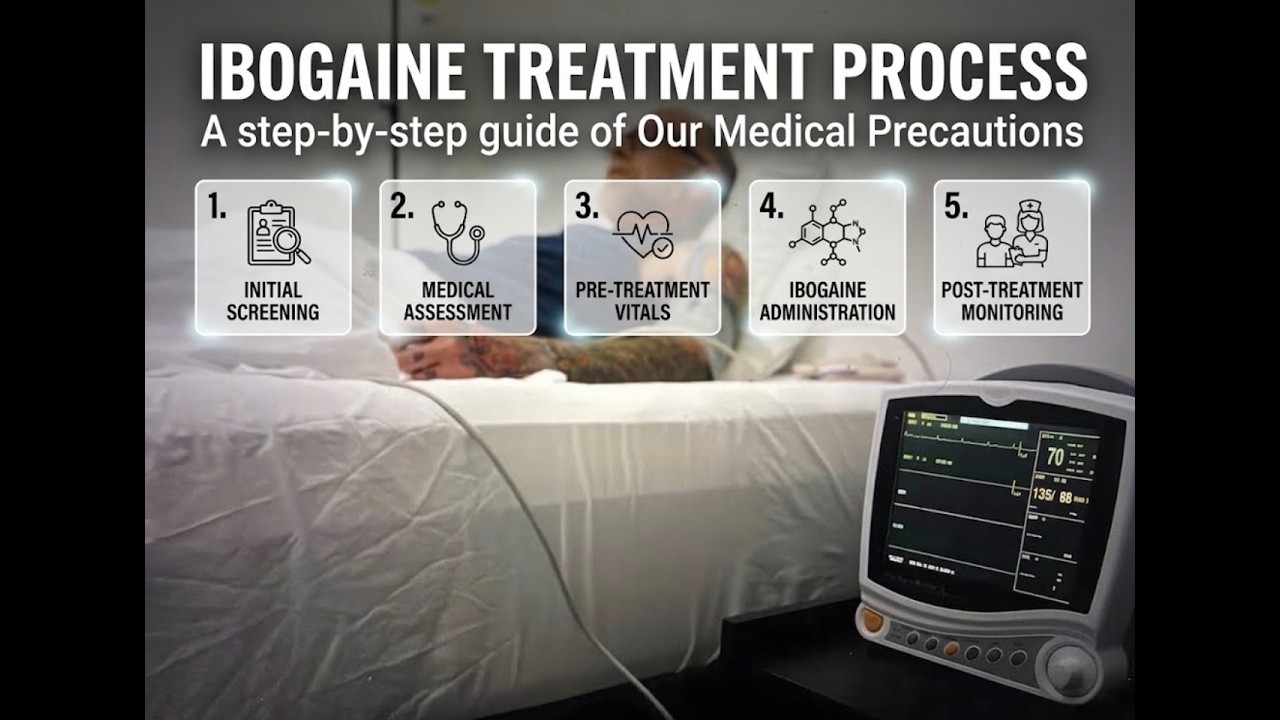
Here is the essential, step-by-step safety protocol utilized in top-tier clinical environments:
-
Comprehensive Medical History Audit: Before any ibogaine treatment is approved, a deep-dive medical history is conducted. In our clinical example, the patient is a 44-year-old veteran who suffered a severe job-site accident resulting in multiple surgeries, including a lumbar spine surgery in August 2024 and the replacement of three discs in his cervical spine in October 2025. Uncovering this trauma is vital for both physical positioning during treatment and psychological care.
-
Medication & Dependency Review: The clinical team meticulously logs every over-the-counter and prescribed medication. Our veteran reported taking 800mg of Ibuprofen three times a day, every day, for years to manage chronic pain, alongside a previous history of dependency treatment back in 2012. Understanding the liver and kidney load is critical.
-
Real-Time Vital Baseline & Telemetry: The patient is hooked up to advanced telemetry. A baseline is established for blood pressure, oxygen saturation, and blood glucose (e.g., verifying a safe fasting glucose level of 71). Most importantly, an EKG is administered to evaluate heart rhythm. Ibogaine cannot be safely administered without a clear cardiac baseline.
-
Staggered, Controlled Dosing: Ibogaine treatment is never administered all at once. The protocol involves delivering a meticulously measured “first dose” or test dose. The team separates the doses, waiting and watching the telemetry monitors to see how the patient’s heart and body react before proceeding with the flood dose.
See More
The Doctor’s Role (Medical Oversight)
The attending physician is the ultimate gatekeeper of safety in any ibogaine treatment program. Their role is to synthesize the patient’s medical history, assess organ function, rule out contraindications, and ultimately clear the patient for the procedure.
During the intake, the doctor acts as a clinical detective. When our veteran reported taking 800mg of Ibuprofen daily for years to manage severe spinal pain, the doctor immediately flagged a critical safety risk: renal toxicity.
“I’m kind of concerned about your kidneys. It’s a lot of medication for too long, two years already,” the doctor noted during the evaluation.
The physician’s role is to adjust the protocol based on these findings, ensuring the patient’s organs can safely metabolize the alkaloid. Furthermore, the doctor is responsible for reviewing the EKG to ensure there are no underlying arrhythmias or a prolonged QT interval that could result in dangerous cardiac events during treatment. The doctor also provides a roadmap for the future, offering hope rooted in medical science:
See More
The Nurse’s Role (Continuous Care)
While the doctor oversees the overarching clinical strategy, the nursing staff executes the physical safety protocols with precision and compassion. The nurse is the constant presence in the room, responsible for hooking the patient up to the vital monitors and ensuring those readings are perfectly accurate for the duration of the ibogaine treatment.
This involves meticulous attention to detail. For example, placing the EKG leads requires perfect skin contact. In the transcript, the nurse handles a common logistical hurdle: if a patient has body hair that prevents the adhesive (“curita”) from sticking, the nurse carefully manages the site to ensure the telemetry monitor reads the heart rate flawlessly. A dropped signal during an ibogaine flood dose is unacceptable.
Throughout the process, the nurses continually check blood pressure, glucose, and oxygen. They instruct the patient to move slowly, remove their glasses, and stay relaxed, creating a physically safe, highly monitored perimeter around the bed. In some modern protocols, nurses may also administer intravenous magnesium to help stabilize the heart’s electrical activity during the treatment.
See More
The Therapist’s Role (Psychological Integration)
Physical safety is only half of the protocol; psychological safety is equally critical. Ibogaine is a oneirogenic (dream-inducing) psychoactive that can bring suppressed trauma, wartime memories, and grief to the surface rapidly. Navigating this experience requires an expert guide.
When the medicine is brought into the room, the therapist’s role shifts into active grounding. They prepare the patient’s mindset to prevent panic and ensure the therapeutic benefits are safely absorbed. The therapist explicitly manages expectations to lower the veteran’s anxiety:
If the patient begins to feel overwhelmed, the therapist is there to guide them back to safety: “Take a deep breath… this is best like a meditation, or go to sleep to put your mind blank.”
By removing the pressure to “have a vision” and framing the experience as a somatic and meditative process, the therapist ensures the veteran’s nervous system remains calm and receptive. Following the active phase of the ibogaine treatment, the therapist steps into the crucial integration phase—helping the veteran unpack their insights, process their TBI or PTSD symptoms, and map out long-term changes to their daily functioning.
See More
The Veteran’s Reality (Integration and Testimonial)
The rigorous medical screening, the EKG telemetry, and the constant nursing oversight all serve one ultimate purpose: allowing the veteran to surrender completely to the psychological process. When a patient’s nervous system intuitively knows they are physically safe, the brain can finally begin to process deeply entrenched trauma.
Following the active “flood dose” phase of treatment, patients enter the integration phase. This is where the therapeutic team helps the veteran unpack the intense, dream-like processing they just endured.
This testimonial highlights the profound difference between symptom management and root-cause resolution. By combining rigid, hospital-grade safety protocols with deep psychological integration, veterans are finally finding a pathway to reclaim their lives.
Learn and Watch about a veterans honest Ibogaine Testimonial
Watch Real Clinic Footage: Medical Protocols in Action
To truly understand the depth of care and rigorous safety measures we have discussed, you can watch it unfold firsthand. In the video below, step inside our clinic to see a patient navigating the intake and treatment process. You will see real footage of the comprehensive blood work, the critical EKG heart monitoring, the compassionate guidance from the therapist, and the continuous oversight provided by our doctors and nursing staff. Take at deep dive into an ibogaine treatment in Mexico
Conclusion: A Call for Safe Access and Continued Research
When veterans seek relief from profound physical and mental trauma, they should not have to choose between suffering in silence or fleeing the country for unregulated care.
As the U.S. government—from the VA to the FDA to the executive branch—finally begins to clear the path for domestic research and clinical trials, the conversation must remain grounded in rigorous science. As demonstrated by this standard intake protocol, medical supervision—driven by doctors, nurses, and therapists utilizing modern telemetry and exhaustive medical histories—provides a fiercely protected, safe environment.
Ibogaine treatment is not a magic bullet, and it carries real medical risks. However, with proper screening, continuous EKG monitoring, and expert psychological support, it represents a profound frontier in mental health care. Veterans have fought for us; it is time our healthcare infrastructure evolves to provide them with the safe, professionally monitored healing they deserve.
Written By Gavriel Dardashti
Medical Review by Doctor Alejandro Villanueva
References
Cherian, K. N., Keynan, J. N., Anker, L., Faerman, A., Brown, R. E., Shamma, A., Keynan, O., Coetzee, J. P., Batail, J.-M., Phillips, A., Bassano, N. J., Sahlem, G. L., Inzunza, J., Millar, T., Dickinson, J., Rolle, C. E., Keller, J., Adamson, M., Kratter, I. H., & Williams, N. R. (2024). Magnesium–ibogaine therapy in veterans with traumatic brain injuries. Nature Medicine, 30, 373-381. https://doi.org/10.1038/s41591-023-02705-w Cited by: 111
Malcolm, B. J., Polanco, M., & Barsuglia, J. P. (2018). Changes in Withdrawal and Craving Scores in Participants Undergoing Opioid Detoxification Utilizing Ibogaine. Journal of Psychoactive Drugs, 50, 256-265. https://doi.org/10.1080/02791072.2018.1447175 Cited by: 90
Mash, D. C., Duque, L., Page, B., & Allen-Ferdinand, K. (2018). Ibogaine Detoxification Transitions Opioid and Cocaine Abusers Between Dependence and Abstinence: Clinical Observations and Treatment Outcomes. Frontiers in Pharmacology, 9. https://doi.org/10.3389/fphar.2018.00529 Cited by: 165
Mestre, D., Paula, A., Gil, F. P., & Vaz, J. (2024). Multiple Episodes of Cardiac Arrest Induced by Treatment With Ibogaine: A Case Report. Cureus. https://doi.org/10.7759/cureus.63487 Cited by: 8
Sharma, R., Batchelor, R., & Sin, J. (2023). Psychedelic Treatments for Substance Use Disorder and Substance Misuse: A Mixed Methods Systematic Review. Journal of Psychoactive Drugs, 55, 612-630. https://doi.org/10.1080/02791072.2023.2190319 Cited by: 35